Kazakhstan Civil Aviation: Market Overview and Key Airlines
Market Review — July 2026
A Market Shaped by Geography and Growth
Kazakhstan's geography makes aviation a structural component of the national transport system. Long distances between major cities, uneven surface connectivity and the country’s position between Europe and Asia create sustained demand for domestic services while supporting ambitions to develop international passenger and cargo flows through Almaty, Astana and Shymkent.
The industry continued to expand in 2025. Kazakhstan’s airports handled 31.8 million passengers, compared with 29.7 million in 2024, and processed 173.3 thousand tonnes of cargo. Total passenger traffic reported for airlines serving the market reached 20.7 million, of which 15.4 million passengers were carried by Kazakh airlines. During the first four months of 2026, domestic carriers transported 4.6 million passengers, airports served 9 million passengers and cargo handling approached 50,000 tonnes.
Fleet growth has accompanied the expansion of traffic. By the end of 2025, Kazakhstan’s commercial aircraft fleet had reached 109 aircraft, including additional Airbus A320-family and Boeing 737 MAX aircraft. The international network covered 135 routes to 30 countries, with 626 flights per week. The authorities expected a further nine aircraft to enter service during 2026, potentially increasing the national fleet to approximately 118 aircraft.
Public Administration and Regulatory Framework
State responsibilities in Kazakhstan’s civil aviation system are divided between the Civil Aviation Committee of the Ministry of Transport and the Aviation Administration of Kazakhstan. The Committee is responsible for government policy, sector development, economic regulation and the broader legal framework. The Aviation Administration performs technical certification, surveillance and oversight in the fields of flight safety and aviation security.
The Aviation Administration was established in August 2019 as part of a fundamental regulatory reform based on the model of the UK Civil Aviation Authority and incorporating elements of European aviation regulation. The separation of policymaking from technical oversight was intended to strengthen the regulator’s professional independence, improve inspector competence and bring Kazakhstan’s supervisory system closer to ICAO and European practices.
Kazakhstan has made measurable progress in aviation security. A comprehensive ICAO audit under the Universal Security Audit Programme Continuous Monitoring Approach, or USAP-CMA, produced a compliance result of 95.7%, placing the country among the leading states in the CIS and within the global top twenty according to the Kazakh authorities. This result relates specifically to aviation security and should not be treated as a universal score covering every aspect of flight-safety oversight.
The country’s regulatory relationship with Europe has also become more established. Kazakh airlines were removed from the EU Air Safety List in 2021. In June 2026, the European Union and Kazakhstan signed a Horizontal Aviation Agreement, replacing nationality restrictions in bilateral arrangements with 17 EU member states and allowing eligible EU airlines to exercise the available traffic rights. The agreement improves legal certainty and creates a stronger framework for further connectivity, although it must pass the parties’ internal procedures before entering into force.
Access to the United States remains a strategic objective rather than an accomplished regulatory milestone. Kazakhstan completed a preliminary technical review under the U.S. Federal Aviation Administration’s IASA programme in August 2024, but that review did not assign the country an IASA category. Legislative amendments approved in June 2026 form part of the preparation for a future full assessment. Direct services to the United States will therefore depend on both regulatory approval and the availability of suitable long-haul aircraft.
Domestic Connectivity and International Routes
Kazakhstan’s domestic network combines commercially viable trunk routes with subsidised services to smaller and more remote communities. In 2025, five Kazakh airlines operated domestic flights on 56 routes. The government subsidised 23 socially important routes carrying approximately 520,000 passengers; the programme was expanded to 24 routes in 2026. These services are particularly important for destinations where low traffic volumes and limited airport infrastructure make fully commercial operations difficult.
International expansion is increasingly diversified. Russia, Türkiye, China, the United Arab Emirates and Uzbekistan remain among the largest external markets, but carriers are also adding or evaluating services to East Asia, the Gulf, Europe and the wider Central Asian region. This reduces dependence on a limited number of international markets while supporting the development of connecting traffic through Kazakhstan’s principal airports.
The country’s “open skies” policy and fifth-freedom arrangements create opportunities for foreign airlines and potentially allow Kazakhstan to capture traffic moving between third countries. However, geographical position alone will not produce a successful transit hub. Competitive connection times, airline schedules, airport service quality, baggage reliability and commercially attractive transfer products will be equally important.
Airport Development and Digitalisation
Almaty and Astana remain Kazakhstan’s two principal passenger gateways. Shymkent is developing as a third major aviation centre, supported by the expansion of SCAT Airlines and plans to increase airport capacity. Aktau, Atyrau, Turkistan and several regional airports also have strategic importance for energy-sector travel, tourism, domestic accessibility and connections across the Caspian region.
The current infrastructure programme includes preparations for second runways at Astana and Shymkent, reconstruction of Almaty Airport’s domestic terminal, apron repairs at Aktau, development of a new terminal at Atyrau and continued work on airports serving Katon-Karagay, Zaisan and Kenderli. The government is also restoring Arkalyk Airport and modernising facilities at Urzhar and other regional locations.
Physical construction is only one part of the challenge. A 2026 assessment by SITA covering 14 state-owned airports found that the average deployment of essential passenger-processing and baggage-handling systems was only 38%. Many processes remained manual. The findings point to a need for greater investment in common-use check-in systems, baggage tracking, passenger-flow management, automated border control and biometric identification.
Kazakhstan has begun developing a Civil Aviation Master Plan through 2050 with ICAO experts. The plan is intended to provide a coordinated framework for airport capacity, airline development, passenger and cargo flows, regulatory reform, workforce requirements, digitalisation and sustainable aviation. Its significance lies in moving the sector away from isolated infrastructure projects towards integrated national planning.
The Airline Market
Kazakhstan’s scheduled airline market is concentrated around three principal competitive platforms:
Air Astana Group, comprising the full-service Air Astana and the low-cost FlyArystan;
SCAT Airlines, the country’s largest privately developed airline group outside Air Astana;
Vietjet Qazaqstan, the new commercial identity being developed from the former Qazaq Air platform.
Smaller operators continue to serve regional, charter, corporate, medical and specialised markets. Their individual scale is limited, but they remain important in a country where many communities cannot economically support regular mainline jet services.
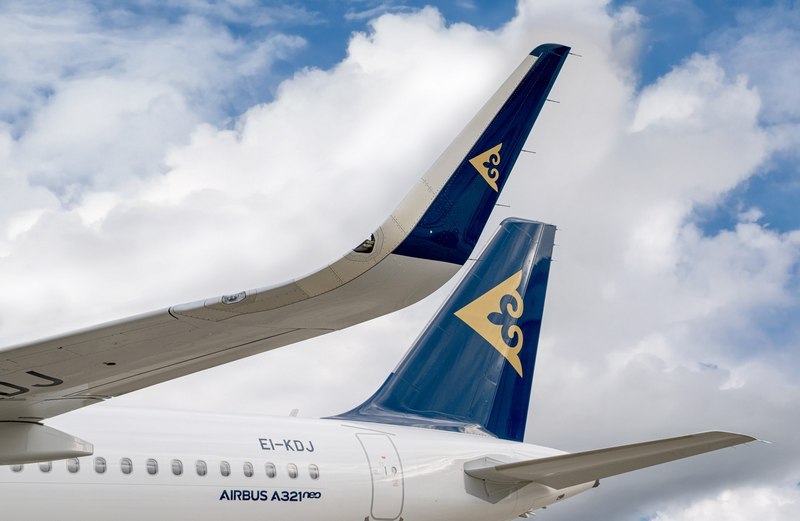
Air Astana Group
Air Astana is Kazakhstan’s flag carrier and the country’s principal international network airline. Together with FlyArystan, it describes itself as the largest airline group in Central Asia and the Caucasus by revenue and fleet size. Its business model combines a full-service carrier focused on domestic, regional, transit and longer-range markets with a low-cost airline targeting price-sensitive demand.
At the end of 2025, the group operated 62 aircraft with an average age of 6.3 years. Air Astana operated 34 aircraft: three Boeing 767-300ERs, three earlier-generation Airbus A320/A321 aircraft and 28 A320neo-family aircraft, including the long-range A321LR. FlyArystan operated 28 Airbus A320-family aircraft, comprising 12 A320ceos and 16 A320neos.
Air Astana’s network combines major domestic routes with services across Central Asia, the Caucasus, China, India, the Middle East and Europe. The A321LR has allowed the airline to develop longer, relatively low-volume routes without the cost base of a widebody aircraft. The three Boeing 767s continue to provide widebody capacity while the company prepares for a transition to the Boeing 787-9.
In November 2025, Air Astana selected up to 15 Boeing 787-9 Dreamliners, in addition to three aircraft due to arrive through leasing companies. If the full programme is completed, the airline could eventually operate as many as 18 Dreamliners. The aircraft are intended to replace and expand the existing widebody operation, increase capacity on established routes and support entry into longer-range markets.
The group is also expanding its narrowbody order book. In March 2026, it finalised a firm order for 25 Airbus A320neo-family aircraft, comprising five A320neos and 20 A321neos. The aircraft will be allocated between Air Astana and FlyArystan and will support both fleet renewal and long-term growth.
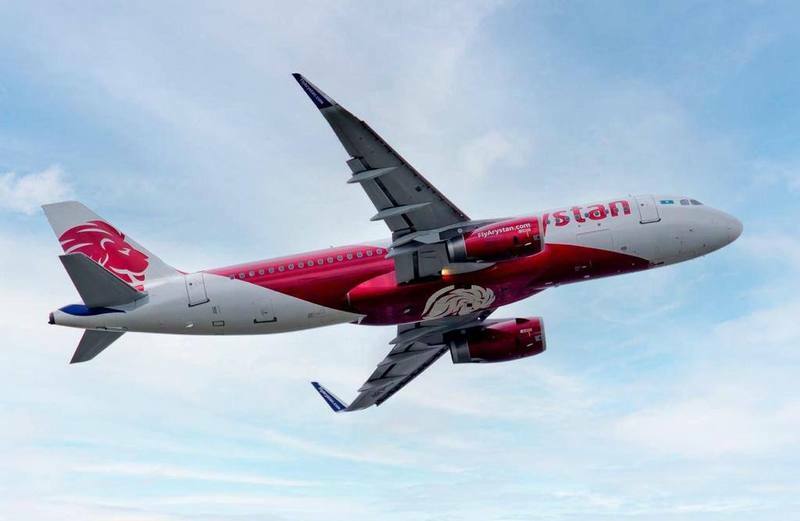
FlyArystan
FlyArystan has substantially changed the structure of Kazakhstan’s domestic market since commencing operations in 2019. Its high-density Airbus fleet and unbundled fare model have stimulated demand among passengers who previously travelled less frequently or relied on rail and road transport.
Domestic services remain central to the airline, but its network increasingly includes regional international destinations in Central Asia, China, the Caucasus and leisure markets. Its role within the group is complementary: Air Astana concentrates on full-service and connecting traffic, while FlyArystan provides lower fares and high aircraft utilisation on price-sensitive routes.
The main strategic challenge is preserving a genuinely low-cost operating structure while using airports and technical resources shared with a full-service parent. Continued fleet growth will also require adequate airport slots, ground-handling productivity and protection from the engine-related availability problems that have affected A320neo-family operators worldwide.
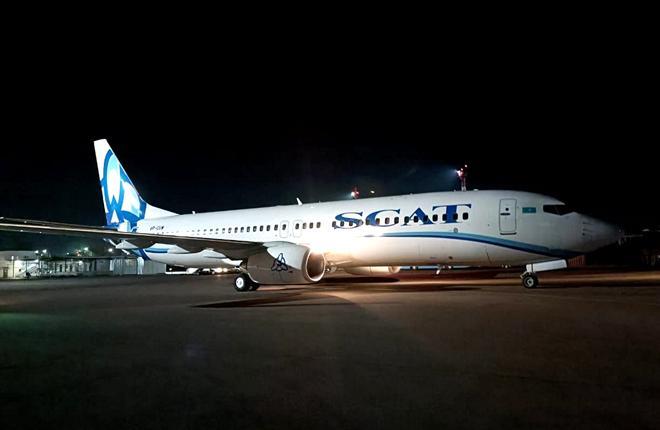
SCAT Airlines
SCAT Airlines is Kazakhstan’s second major airline platform and the principal privately developed competitor to Air Astana Group. Based in Shymkent, it operates domestic and international services using a fleet centred on Boeing aircraft.
SCAT has become one of Boeing’s most important customers in Central Asia. In April 2026, Boeing described the airline as operating nearly 40 Boeing jets and announced an order for five additional 737-9s. SCAT also converted five aircraft from an earlier 737-8 commitment to the larger 737-9, reflecting demand for greater capacity and range on international routes.
The airline’s development is closely linked to Shymkent’s emergence as an alternative hub. Additional runway and terminal capacity could allow SCAT to expand connecting services without facing the same infrastructure and slot constraints as the largest airports. Its mixture of domestic, regional and longer international routes gives it a different network profile from both Air Astana and FlyArystan.
SCAT is also preparing to enter dedicated air-cargo operations. In July 2026, the airline reached an agreement with Boeing to convert a 767-300ER into a 767-300 Boeing Converted Freighter. The aircraft is expected to become the first 767-300BCF operated in Kazakhstan and will be used for general and express freight. This could give the country’s cargo market a stronger locally based widebody operator rather than relying predominantly on foreign freighters and passenger belly capacity.
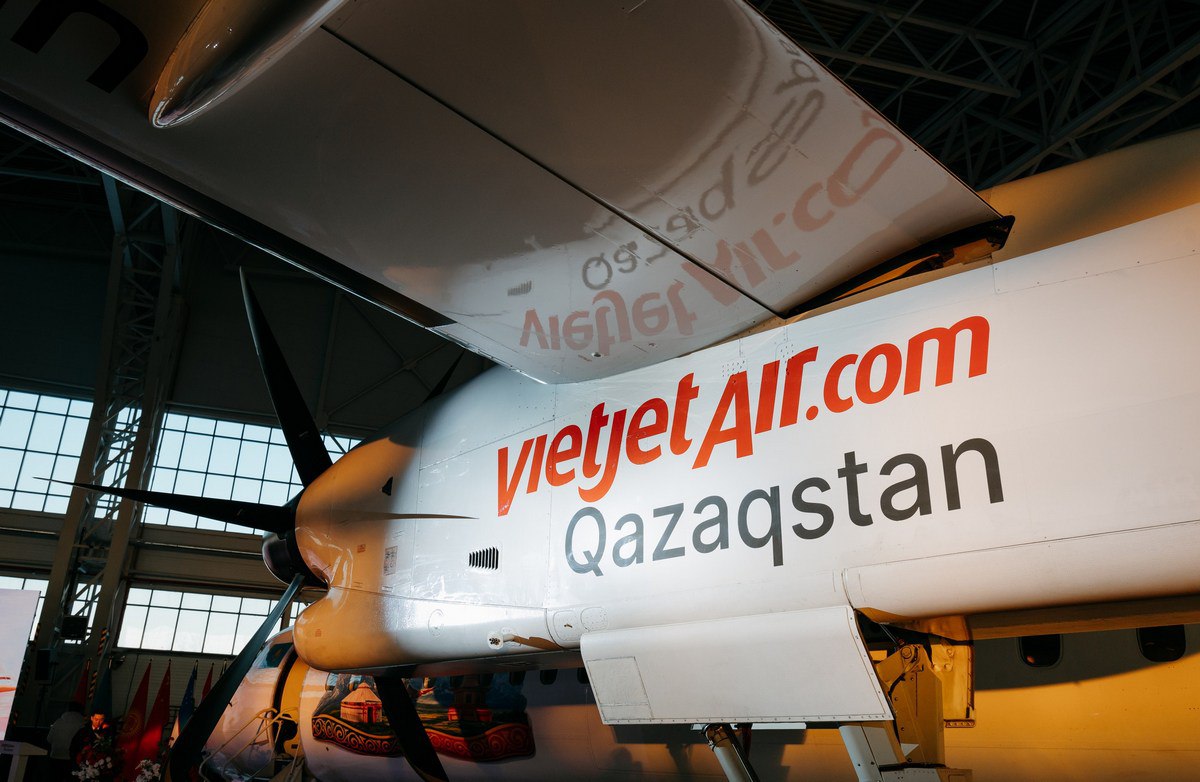
Vietjet Qazaqstan
The most significant recent structural change in Kazakhstan’s airline market is the transformation of Qazaq Air. Established in 2015 to support regional connectivity, Qazaq Air developed a network serving domestic and nearby international destinations.
The airline’s privatisation was completed on 6 May 2025. Its current shareholders are Samruk-Kazyna with 49%, Central Asia Aviation Holdings—part of Vietnam’s Sovico Group—with 49%, and Kazasia Holdings with 2%. Qazaq Air and Vietjet simultaneously announced their strategic partnership and the launch of the Vietjet Qazaqstan brand.
The partnership creates the possibility of transforming a relatively small regional operator into a broader low-cost platform. Vietjet contributes experience in high-density narrowbody operations, commercial distribution and rapid network expansion, while the Kazakh company provides an existing operating certificate, local market knowledge and an established domestic presence.
The transition will nevertheless take time. Introducing a new jet fleet, retraining personnel, adapting maintenance and operational systems and repositioning the network are more complex than changing the commercial brand. The airline’s eventual impact will depend on how quickly it can build scale and whether it can compete effectively against both FlyArystan’s established low-cost operation and SCAT’s expanding network.
Outlook
Kazakhstan’s civil aviation industry has entered a more demanding phase of development. The initial story was one of traffic recovery, regulatory reform and rapid fleet expansion. The next phase will depend on whether the supporting system can keep pace with airline growth.
The market has several clear strengths: sustained domestic demand, a growing international network, modern aircraft orders, increasingly diversified airline competition and a government policy that treats aviation as strategically important. The EU agreement, the planned ICAO-supported master plan and preparation for the FAA IASA process could further integrate Kazakhstan into the global aviation system.
The constraints are equally significant. Airport systems outside the main hubs remain uneven, major infrastructure projects require coordinated implementation, and the sector faces a persistent shortage of qualified personnel. Civil aviation directly employs approximately 25,000 people, while annual demand exceeds 600 additional specialists. The government is therefore considering a certified national aviation training centre developed with an international partner.
Kazakhstan’s ability to become a stronger regional aviation hub will ultimately depend not only on adding aircraft and routes, but on improving operational reliability, transfer quality, airport digitalisation, regulatory predictability and human-capital development. The industry’s growth potential is substantial, but converting that potential into a durable competitive position will require the airline, airport, regulatory and training systems to develop at the same pace.