Uzbekistan Civil Aviation Overview
Market Review — July 2026
Uzbekistan’s civil aviation sector has rebounded rapidly from the pandemic, driven by rising travel demand and government reforms. The country (population ~39 million) saw its airport system handle about 15.5 million passengers in 2025, a 15% increase over 2024. This growth was led by the flag carrier, Uzbekistan Airways, which carried roughly 6 million passengers in 2024. At the same time, cargo traffic is expanding (98,100 t in 2025), reflecting Uzbekistan’s role as a land-bridge between Europe and Asia. In response to rapid expansion, the government has restructured the sector since 2018, separating national airline and airport operations and creating a new civil aviation agency (Uzaviatsiya) in 2020 to oversee safety and regulation. Major infrastructure projects (a new Tashkent airport, modernized regional airports, and a cargo hub at Navoi) and new airline entrants (private carriers and low-cost operators) aim to capitalize on this growth.
Uzbekistan’s Aviation Market
Air travel plays a critical role in connecting Uzbekistan’s large landlocked territory. In 2025, Uzbek airports handled roughly 15.5 million passengers (+15% vs 2024). International traffic dominates – about 12.7 million were foreign and transit passengers – while domestic travel (2.8 million) remains smaller. Uzbekistan Airways (UzAir) carried about 6.0 million passengers in 2024, with the remainder served by private and foreign carriers. The nation’s cargo volume at airports reached nearly 98,100 t in 2025. Over the last two years, traffic has bounced back strongly: UzAir reports 4.2 million passengers in 2022 and a record 5.0 million in 2023.
Aviation is vital for tourism (UNESCO sites in Samarkand/Bukhara), business travel and trade. Uzbekistan’s geographic position between Europe and Asia underpins its ambition to become a transit hub. Despite growth, per-capita air travel remains low, so demand is expected to continue rising with economic expansion. For example, Uzbekistan’s GDP growth was about 7.6% in 2025 (IMF) and the economy is forecast to expand ~6.5% in 2026. Airlines and airports alike are expanding routes: UzAir now serves over 75 international destinations, including new services to Munich, Jakarta and Phuket in 2023. Foreign carriers have also been added – in 2025 alone four new carriers began flights to Uzbekistan (e.g. Air China, China Eastern, AirAsia, T’Way). The government’s target is to reach ~24 million passengers by 2030, underscoring both opportunities and infrastructure needs ahead.
Liberalisation and Regulatory Framework
Since 2018 Uzbekistan has reformed its aviation sector to promote investment and competition. A 2018 presidential decree “On radical improvement of civil aviation” legally separated Uzbekistan Airways and the airport operator into two joint-stock companies. Starting January 1, 2019, the State Aviation Concern was split: Uzbekistan Airways JSC became the national airline, and Uzbekistan Airports JSC took over airport assets. Air traffic control (Uzaeronavigatsiya) remains state-run, while a new independent flight-safety inspectorate (now the Civil Aviation Agency “Uzaviatsiya”) was established in 2020. Today Uzaviatsiya (under the Ministry of Transport) is responsible for safety oversight and certification, reflecting Uzbekistan’s move to an international-standard regulatory model.
Regulatory policies have also opened the market. In 2020 Uzbekistan implemented an “open skies” regime at all airports: foreign airlines can operate unrestricted passenger services to most cities (with use of 5th-freedom rights on many routes) and even 7th-freedom cargo flights via Navoi and Termez. This policy (initially for two years, with extensions) has enabled carriers like AirAsia and Air China to launch routes. On safety oversight, Uzbekistan is rated FAA Category 1 as of 2025, meaning its regulatory framework meets ICAO standards. (Uzbek carriers are not subject to any EU safety ban.) In 2026 the government plans for Uzaviatsiya to become self-financing (per a new decree), indicating ongoing reform of the oversight system.
Airports and Infrastructure
Uzbekistan has 18+ airports (10 international). The New Tashkent Airport project is the centerpiece: announced Oct 2025, it will occupy 1,310 ha with a 20 million pax initial capacity and 129,000 t cargo capacity. The first phase (30 flights/hour capacity, two runways, one 152,000 m² terminal) will cost ~$2.5 billion. This will replace (and vastly augment) the current Tashkent International (formerly Yuzhny) airport, which handled ~9 million pax before expansion.
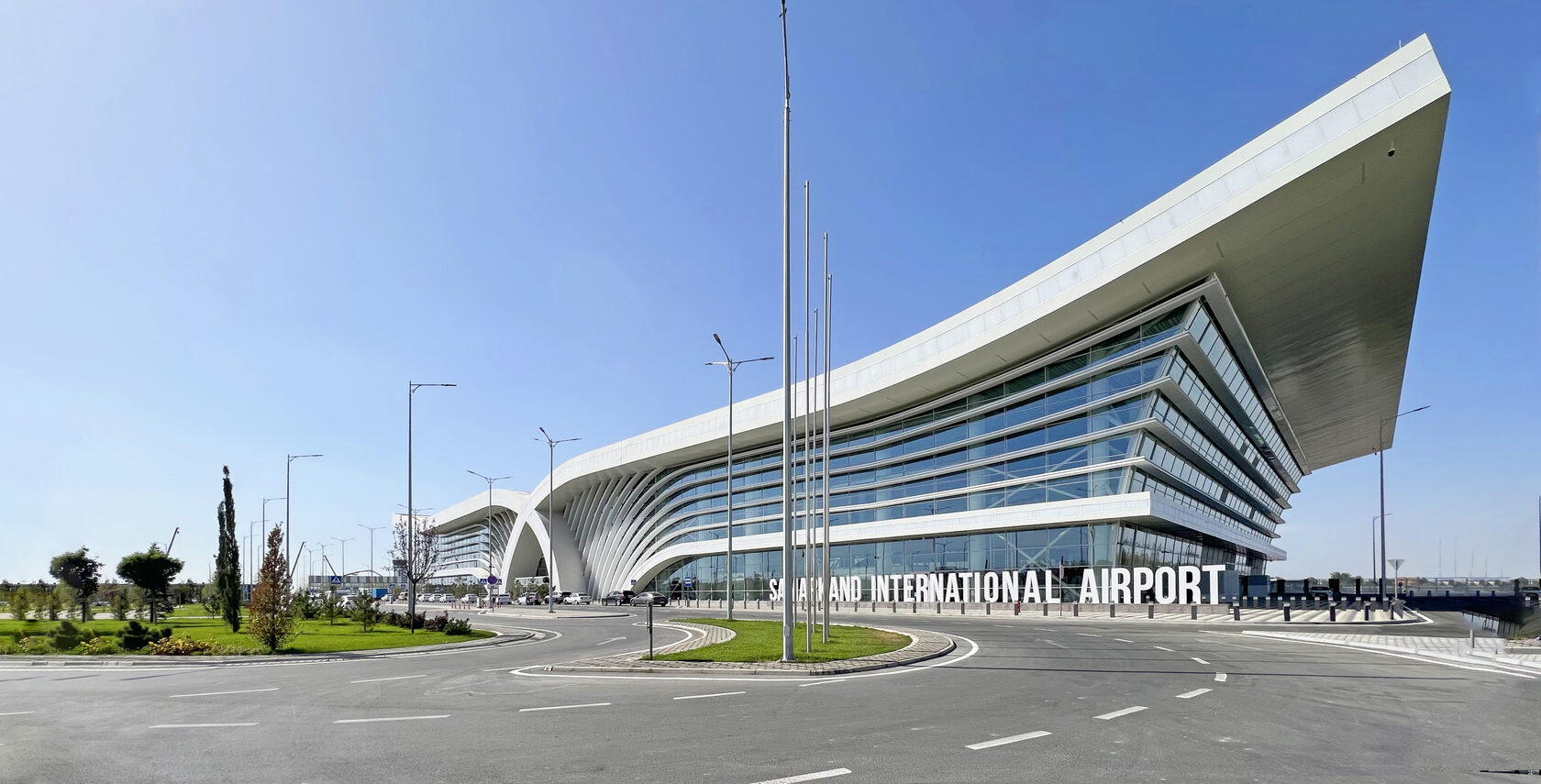
Other major airports are also being upgraded. Samarkand’s new terminal (built under a PPP) opened in 2021. The private concessionaire Air Marakanda (a Uzbek-Turkish consortium) operates the 3 million pax terminal. By 2025 Samarkand’s traffic hit ~1.5 million (up 10% in a year), serving 24 airlines to about 30 destinations. The facility includes modern passenger amenities (e-gates for border control, CIP lounge) and is ISO-certified for quality and security. In Jan 2026 Samarkand inaugurated a railway link to its airport, further improving access.
Navoi International is being positioned as a China-Europe cargo hub. It lies within a free economic zone managed by UAE’s DP World (2019 concession renewed and expanded in 2022). Navoi has a 100 kt cargo terminal and is building a new 16,000 m² terminal with expansion to 2 million cubic meters for freight. Fuel storage at Navoi will reach 15,000 t when a new fuel terminal is completed. Once completed, Navoi is expected to handle large-scale transit flows. (However, throughput remains modest: only ~18.6 kt cargo moved there in 2022.) Carriers now serving Navoi include Uzbekistan Airways, Maersk Air, MNG, Silk Way West and others; the first Uzbekistan–Europe freighter (MyFreighter) began service in 2025.
Several regional airports are also being modernized. In Urgench, an Incheon (Korea) consortium won an Oct 2025 PPP to upgrade and manage the airport. In Mar 2026 the government launched an international tender for New Bukhara Airport (Yangi Bukhara), a PPP project to build a 48,500 m² terminal handling 1,600 passengers/hour. Smaller upgrades include runway extensions and terminal facelifts at Namangan, Termez and others. In 2023–24, two new domestic airports were opened: Kokand Airport (March 2024) and Zaamin (Jizzakh region, 2023), both served by daily Uzbekistan Airways L-410 flights to revive air service in remote areas.
Digitalization initiatives are also underway. For example, Samarkand’s terminal uses biometric passport e-gates for faster border control. All major airports now offer free Wi-Fi and online check-in options; Uzbekistan Airways plans to roll out full mobile ticketing. Uzbekistan Airports (the state airport operator) and airlines are gradually implementing integrated traffic monitoring and security systems to improve safety and passenger flow.
Airline Market Structure
The Uzbek airline market is a mix of the state-owned flag carrier and emerging private firms. Uzbekistan Airways dominates (75% of pre-reform traffic) but new entrants have grown quickly since 2021. The key private carriers include Qanot Sharq, Centrum Air (parent of MyFreighter), FlyOne Asia, and Silk Avia. These vary in business model: Qanot and Centrum operate primarily Airbus narrowbodies on scheduled and charter routes; Silk Avia is a domestic low-cost operator with ATR turboprops. LCC developments are also underway: FlyOne Asia (a joint venture with Moldova’s FlyOne) was launched in 2025, and other investors have proposed carriers (e.g. HUMO Air, now defunct).
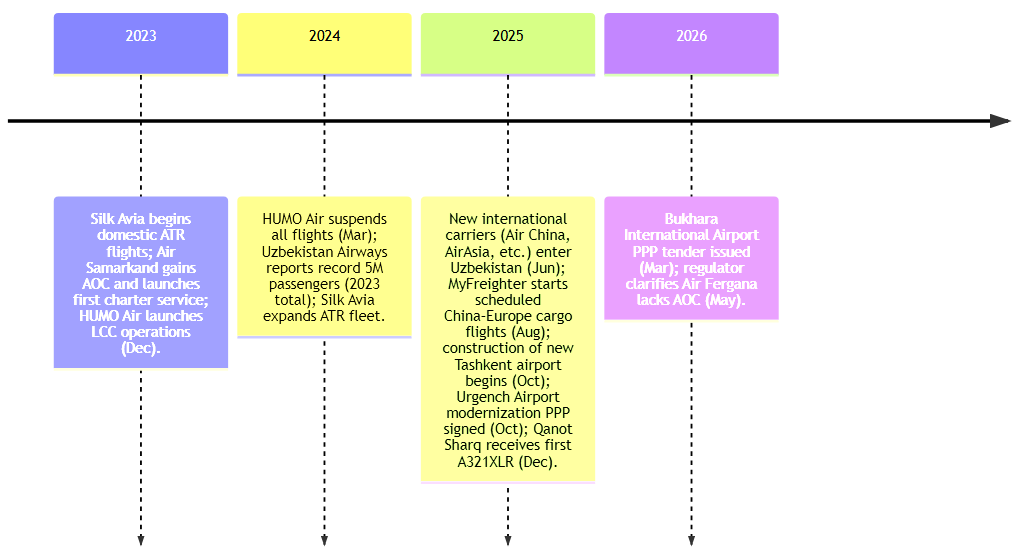
Several earlier ventures have faltered. HUMO Air (a state-backed LCC) briefly relaunched in Dec 2023 but suspended operations in March 2024. Panorama Airways (a charter airline with an A330) launched in late 2022 but ceased by Aug 2024. A planned low-cost brand “Air Fergana” remains uncertified – regulators confirmed in May 2026 that it has no AOC. In contrast, Silk Avia (Uzbekistan Helicopters’ subsidiary) started domestic ATR flights in April 2023 and now serves 15 cities. Another new carrier, Air Samarkand, received its AOC in Dec 2023 and began passenger services (including long-haul charters and one route to Istanbul) immediately thereafter, but ceased operations in 2026.
Today’s civil aviation market comprises the national carrier Uzbekistan Airways, several medium-sized private airlines such as Qanot and Centrum, one low-cost airline (Silk Avia), and rapidly expanding startups like FlyOne Asia. Cargo operators such as MyFreighter and smaller charter airlines like Fly Khiva have also entered freight niches. Several announced carriers remain inactive: Air Fergana (which does not hold a valid AOC), the former LCCs HUMO and Panorama, and Air Samarkand, which has ceased operations. Overall, liberalization since 2020 has increased competition on key international routes (especially to Russia, CIS and East Asia), though Uzbekistan Airways still holds a dominant position on domestic routes.
Uzbekistan Airways
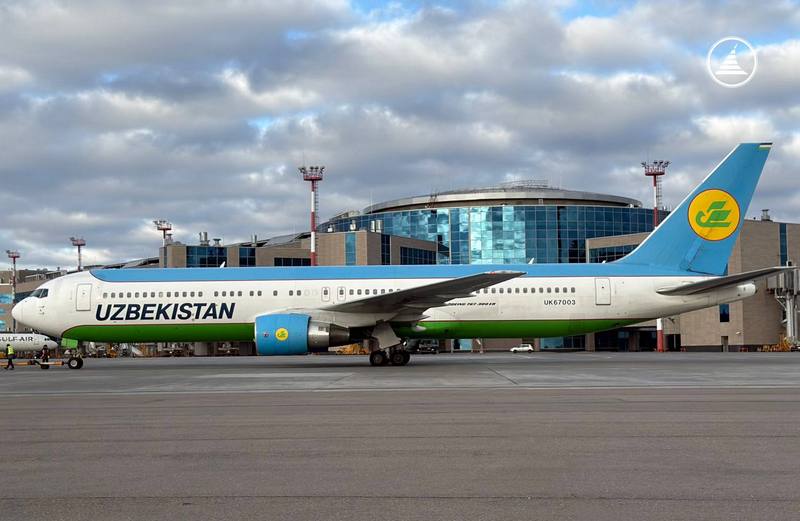
Uzbekistan Airways (UzAir) is the nation’s state-owned flag carrier, headquartered in Tashkent. In 2022–23 it carried 4.2 million and 5.0 million passengers respectively, making it one of Central Asia’s largest airlines. UzAir operates a mixed fleet of ~39–45 aircraft: widebody Boeing 767-300ER and 787-8s, Airbus A330s, and narrowbodies (Airbus A320ceo/neo, A321ceo/neo) as well as regional turboprops (5 ATR 72-600s) and Let L-410s. Its network covers 75+ destinations on four continents, including major cities in Russia/CIS, Europe (Munich, Rome from 2024), Middle East and Asia. In 2023 it resumed several long-haul routes (Beijing, Jakarta, Bangkok, etc.) and added new ones (Munich, Ankara).
UzAir has several subsidiaries: Uzbekistan Airways Express (an LCC brand), Uzbekistan Helicopters LLC (executive/charter flights), Uzbekistan Airways Technics LLC (MRO services), plus catering and training divisions. The airline has steadily modernized its fleet (adding 5 A320neo and 2 L-410 in 2023) and expects 20+ new aircraft in 3–5 years. A privatization plan has been mooted (with World Bank advice), but as of 2026 Uzbekistan Airways remains fully government-owned. Its financial results have improved with higher traffic; cargo flights are operated both on mainline and via dedicated charters.

Major Private Carriers
Qanot Sharq (Tashkent-based) was relaunched in 2021 with new A320s and now serves ~30 destinations (Tashkent and Samarkand hubs). Its fleet of 7 airliners (mostly A320ceo) is being expanded: in Dec 2025 it received its first Airbus A321XLR (of 4 on order), as well as orders for two A321LRs. Qanot operates regional routes plus charter leisure services to destinations like UAE and India.
Centrum Air (inc. MyFreighter) is a Tashkent/Samarkand-based group. Centrum operates passenger A320/A321 flights (fleet ~15, scheduled and charter) and fully owns the cargo carrier
MyFreighter holds a separate AOC and now flies 10 freighter jets (nine Boeing 767s and one B757), serving express cargo routes from Tashkent to Europe and Asia. Centrum/MyFreighter has opened numerous interline partnerships but no additional orders have been announced beyond its current fleet.
FlyOne Asia (formerly Asia Union Airlines) is a joint venture with Moldova’s FlyOne. Acquired in mid-2025, it operates Airbus A320s on regional routes. The carrier has one A320 and plans to launch as a low-cost carrier. (Its AOC status is active under the new brand.)
Silk Avia (Uzbekistan Helicopters) is a domestic LCC. It began services on Apr 25, 2023, with ATR 72-600s. Silk Avia’s fleet (8 ATR72s as of 2024) serves 15 domestic destinations and will expand further – it has a confirmed order for five additional ATR 72s (three delivered in 2023). Silk Avia provides a budget product on short-haul routes (e.g. Tashkent-Kokand, Nukus-Urgench) and is upgrading Tashkent’s old LCC terminal.
HUMO Air was a state-sponsored LCC (UzAir initiative). It received an AOC in 2020, relaunched flights Dec 15, 2023 (four A320s), but abruptly suspended services on Mar 11, 2024. It appears defunct.
Panorama Airways obtained an AOC in late 2022 and briefly flew charter A330 services in 2023, but ceased operations by Aug 30, 2024.
Air Samarkand (SamAir LLC) was an Uzbek start-up airline that launched operations in late 2023. It received its Air Operator Certificate on 27 Dec 2023 and began charter flights on Dec 29, 2023, followed by scheduled service in March 2024. The carrier operated a small fleet of Airbus aircraft (A321neo and a leased A330‑300), serving routes from Samarkand to Istanbul, Nha Trang (Vietnam), Saudi Arabia and other regional destinations. In its first year (2024) Air Samarkand flew roughly 1,200 flights and carried about 152,600 passengers. However, financial problems forced the suspension of its international routes: flights to Tel Aviv and Istanbul were halted in October 2025 (with a tentative plan to resume in spring 2026 that never materialized). By early 2026 the airline had effectively ceased operations and returned its aircraft, leaving only a corporate shell; no public notice of AOC revocation has been issued, but the carrier remains inactive.
In summary, Uzbekistan’s airline sector now comprises the state flag carrier (Uzbekistan Airways) alongside a handful of private operators. Key active airlines include Qanot Sharq (a private full-service carrier), Centrum Air (with its affiliated MyFreighter cargo arm), Silk Avia (regional turboprop services) and FLYONE Asia (a new low-cost joint venture that began flights from Tashkent in 2026). In contrast, carriers such as Humo Air, Panorama Airways and Air Fergana have already halted or failed to commence regular service, illustrating the risks of market entry. All currently operating Uzbek airlines hold valid Uzbek AOCs, and Uzbekistan retains FAA Category 1 status – indicating that its safety oversight meets ICAO standards and its regulatory regime is recognized as internationally compliant.
Cargo Aviation and Transit Ambitions
Uzbekistan has placed strong emphasis on cargo transit. Navoi International is at the center of these ambitions. It hosts a free economic zone managed by DP World (since 2019). In 2023 Navoi opened a new 16,000 m² cargo terminal (with satellite tracking, high-capacity warehouses and expanded fuel farms) to attract Europe–Asia freighters. Uzbekistan’s long-term goal is to handle ~100,000 t/year through Navoi, but actual throughput remains low: just ~18,600 t moved there in 2022. Still, the range of operators is growing. Maersk Air Cargo, MNG Airlines, Silk Way West and Turkish freighters now call Navoi; Uzbekistan Airways also flies cargo (using its fleet of ATRs and charters of widebodies).
MyFreighter is the most ambitious newcomer. Founded by the owner of Centrum Air, it now operates a fleet of Boeing 767 and 757 freighters. In August 2025 it launched Uzbekistan’s first scheduled China–Europe cargo service (Shanghai–Tashkent–Amsterdam), reflecting its strategy to connect local producers with global markets. MyFreighter has signed multiple interline deals (with e.g. Biman Bangladesh, Air Serbia) to feed cargo into Tashkent’s hub. Its expansion (with six B767s delivered by late 2025) marks Uzbekistan’s emergence in air freight networks.
Uzbekistan Airways also runs its own cargo business (including an express subsidiary). It flies charter cargo flights between Uzbekistan and various countries (for example, hauling perishables from Central Asia). To support all this, Navoi’s free-zone status was expanded in Dec 2022 to include UAE-based companies, aiming to attract logistics firms. In short, the cargo sector is a key opportunity: geographic position and investment have improved infrastructure. However, utilization must rise for ambitions (the gap between capacity and traffic) to be met. Uzbekistan’s transit strategy depends on developing airline partnerships and integrating Navoi into global cargo networks.
Maintenance, Training and Support
Uzbekistan’s aviation support infrastructure is growing. The leading provider is Uzbekistan Airways Technics (UAT), the MRO arm of UzAir. UAT already performs heavy maintenance: in 2023 it carried out 27 heavy checks and 128 base/line checks on UzAir and other aircraft. It is expanding – constructing new hangars capable of servicing widebodies (B787, A330) and the upcoming 737 MAX. UAT has a long-standing partnership with Lufthansa Technik (30+ years) for training and technical support, which has helped local engineers meet international standards. In 2024 UAT plans to introduce AMOS digital maintenance software to streamline operations.
Private airlines are starting their own maintenance programs. Qanot Sharq now performs its own line maintenance on its A320/A321 fleet. Similarly, the MyFreighter group has announced plans to open its own line-maintenance station; for now it outsources line/tech checks to UAT. Another start-up, Fly Khiva (cargo charter operator), has expressed intent to develop in-house line capability. In short, Uzbekistan’s MRO sector is advancing: from sole reliance on UAT and foreign partners toward some self-sufficiency for newer carriers.
Training is handled by a mix of domestic and foreign programs. UzAir and Silk Avia crews are partly trained at the Uzbekistan Airways Training Centre (ICAO-standard simulators) in Tashkent. Many pilots, especially ATR and Airbus types, go abroad for type-rating: for example, a Bangkok training center (Acron Aviation) was contracted by Centrum Air for ATR/airbus pilot courses. General aviation technical training is provided by government flight schools (for Antonovs, Mi-8 helicopters, etc.). Support services like ground handling, catering and airport security are gradually being upgraded by professional companies (often spin-offs of UzAir subsidiaries) to international standards.
Outlook
Uzbekistan’s aviation industry is on a growth trajectory but faces both opportunities and challenges. On the upside, passenger demand is strong (UzAir saw 5 million fliers in 2023) and the government’s open-skies policy creates room for competition. Infrastructure investments – the Tashkent airport project, modernized regional facilities and Navoi’s cargo expansion – will further increase capacity. The nascent private airlines and new foreign routes indicate a maturing market. Macroeconomic conditions remain supportive: Uzbekistan’s economy grew ~7.6% in 2025 and is forecast to expand ~6.5% in 2026, albeit with inflation around 7–10%.
Risks include execution of these large projects (funding and timelines), and ensuring airlines remain profitable amid fuel price volatility and global travel fluctuations. The ambitious targets (e.g. doubling traffic by 2030) hinge on continued regulatory reform and market liberalization. Overall, industry analysts view the outlook as positive: Uzbekistan’s strategic location and growing middle class should drive traffic, provided that infrastructure keeps pace and carriers adapt to a more competitive environment.
| Operator | AOC | Fleet (Types) | Confirmed Orders |
| Uzbekistan Airways | Yes (state) | ~39 aircraft (B767-300ER, B787-8; Airbus A320ceo/neo, A321ceo/neo, A330; ATR-72, Let L-410) | (no public orders) |
| Qanot Sharq | Yes | 7 (Airbus A320/A321 family) | 3×A321XLR + 2×A321LR |
| Centrum Air | Yes | ~15 (Airbus A320/A321) | – |
| MyFreighter | Yes (Cargo) | 10 (9×Boeing 767-300F, 1×B757-200PCF) | – |
| FlyOne Asia | Yes | 1 (Airbus A320) | – |
| Silk Avia | Yes | 8 (ATR 72-600) | – (5 ATRs delivered in 2023) |
| HUMO Air | No (ceased) | 4 (Airbus A320, returned) | – |
| Panorama | No (ceased) | 1 (Airbus A330, returned) | – |
| Air Samarkand | Yes | 6 (5×Airbus A321neo, 1×A330-300) | – |
| Air Fergana | No (planned) | 0 | – |
Sources: Official Uzbekistan aviation statistics and agency releases; State media and Uzaviatsiya announcements; ICAO/FAA reports; airline/airport press releases; reputable news outlets.